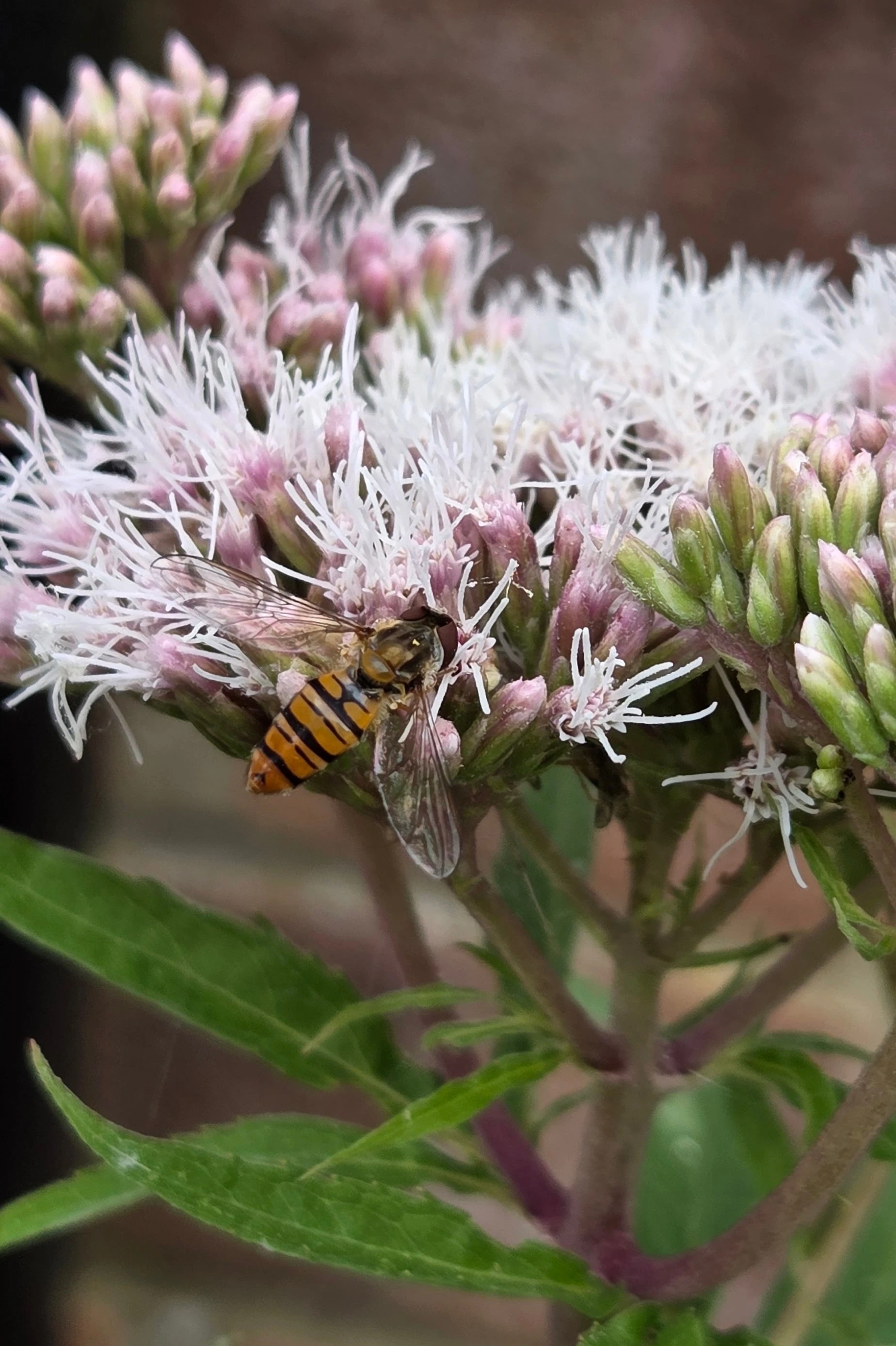
High summer in my garden had me journalling “frothy-flowered” Hemp-agrimony and a stripy Marmelade hoverfly that was among a host of insects attracted to it.
Hemp Agrimony

Also known as “Raspberries and Cream”, Eupatorium cannabinum is a vigourous, tall perennial with a red stem and long, serrated, trifolate leaves.
In the wild it is commonly found in damp meadows, stream edges and woodland margins. In summer it produces a frothy mass of pale pink flower clusters that is insect heaven. Each individual floret contains five tiny petals and long white hairs that will become a parachute for the eventual black seeds.
Gardening Value of Hemp Agrimony
The plant is robust and easy to grow as it self-seeds readily. Its height and contrasting red violet stalks and grass green foliage mean it is easy on the eye. It works well at the back of a mixed border in a sunny but moist position where it will flower during July and August.
Wildlife value of Hemp Agrimony
Because of its tall height, long flowering period and profuse platform of flower clusters, it is extremely attractive to a wide range of pollinators including bees, butterflies, hoverflies, and other insects.
Its foliage forms the caterpillar host for the larval stage of the Hemp-agrimony Plume moth, Adaina microdactyla, the Scarce Burnished Brass moth and for leaf mining flies, Liriomyza eupatorii.
Its also used as an alternative caterpillar host plant by the attractive Frosted Orange moth, which I have recorded in my garden, as well as V-pug moths, which feed on the flowers and developing seeds.
Garden photos of pollinator species found that use Hemp-agrimony for nectar or as a plant host:


Marmalade Hoverfly

Episyrphus balteatus is a common and widespread hoverfly that is both a resident and migrant species at the same time.
It acquired its common name due to the phrase “thick cut, thin cut” describing the wide and narrow alternating marmalade orange stripes on its abdomen.
Migrants have been found to have an internal compass to select the right direction when migrating and to use behavioural tactics to select the best wind.