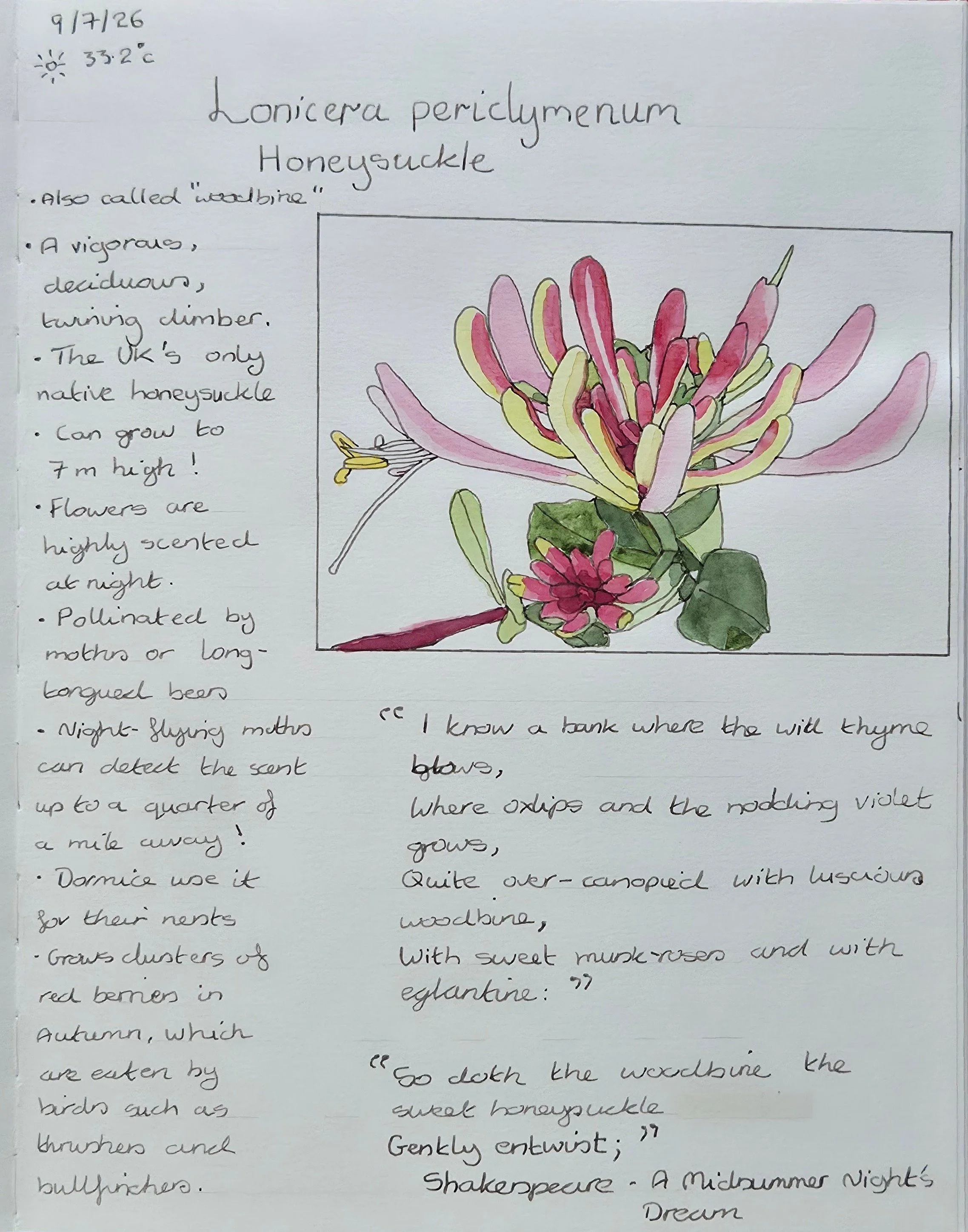
Nature journalling a honeysuckle flower
This was a nature journal challenge simply to find and then to trace on paper something you saw in nature. The aim was to make the exercise accessible to anybody, no matter what their experience or artistic skill.
This exercise would be a great start point for a new nature journaller to try, even practising it a few times, particularly if lacking confidence in drawing and visual representation. I traced pictures onto my nature journal pages most of the time for about 6 years.

The Trace It Challenge
- Find and print a photo of something in nature (or use a picture in a book).
- Get a piece of tracing or greaseproof paper and trace a simple outline of it into your journal.
- On the page answer the following questions:
- what is it?
- where & when did you see it / find the photo?
- what did you notice while tracing it?
- why did you choose it?
- how does it make you feel?
- is there anything else it brings to mind? (e.g. a poem, I wonder why… , It reminds me of…)
Tracing is an excellent way to make yourself focus on the main shapes and lines the subject has and it can be done in a very mindful way too, because following a line precisely with a graphite pencil takes focus and concentration.
The challenge includes answering a series of nature jouralling questions about the experience to prompt curiosity to learn more about the subject being traced.
My answers were
- What Is It?
Honeysuckle aka Woodbine or Lonicera flower - Where and When did you see it?
I saw it in my front garden, right by my doorstep. - What did you notice when tracing it?
While I traced it I noticed the one long stamen on the open flower, and the long tubular shape of the flower. - Why did you choose it?
I picked it because I found the tube shapes interesting and it was just coming into flower. - How does it make you feel?
It made me feel proud of my garden and I enjoyed how beautiful the colours and shapes were. - Does it bring anything else to mind?
It brought to mind Shakespeare, because I remembered it’s mentioned in a few scenes in his work. This turned out to be in A Midsummer Nights Dream which is fitting as its kind of midsummer, temperature-wise at least!
I also wondered why the tubes are so long because it makes it harder for a lot of insects to pollenate it. Only ones with very long tongues can. I guess it just evolved that way to appeal to particular species.
Curiosity
Afterwards, I looked up the Shakespearian references that I couldn’t quite remember exactly and added it to my journal page. I also got curious, went down a few rabbit hole and added a few facts that I found out about its usefulness to wildlife to my entry.
Poetry from “A Midsummer Night’s Dream”
I know a bank where the wild thyme blows,
Where oxlips and the nodding violet grows,
Quite over canopied with luscious woodbine,
With sweet musk roses and with eglantine
William Shakespeare
So doth the woodbine the sweet honeysuckle entwist;
William Shakespeare
My finished traced nature journal page on Honeysuckle:
