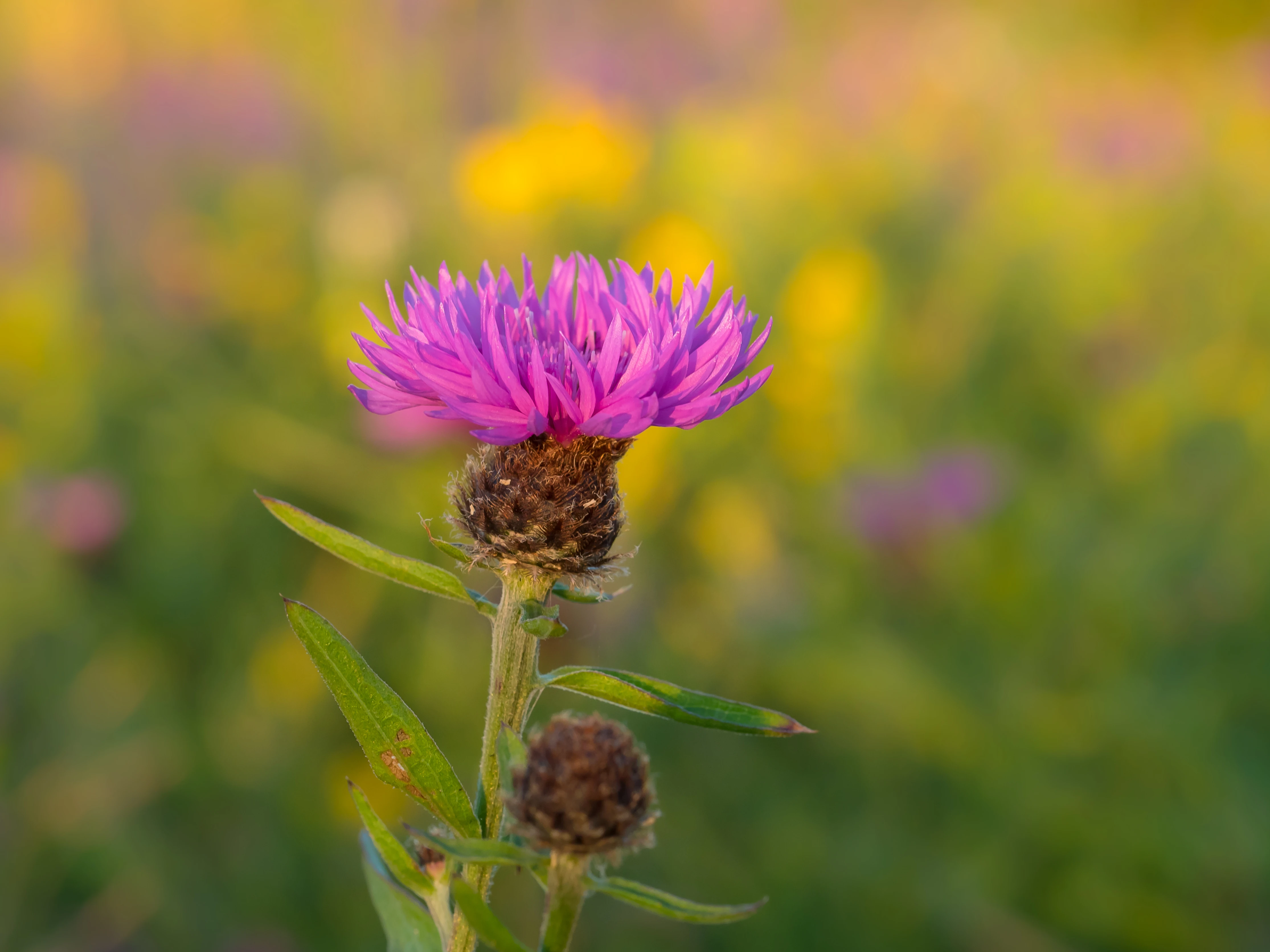
I always know we’ve hit the heights of summer when my wildflower meadow patch is an ocean of vivid magenta Knapweed flowers all out in full and you can hear the impatient chattering of Goldfinches gathering to wait for the impending feast of fresh seed.
As is often the case, this wildflower’s rather unglamorous name belies both the vibrant beauty of this vivid, fuchsia-coloured wildflower and its importance to our native wildlife.
There are two native species of Knapweed:
- Centaura nigra – Common Knapweed
- Centaura scabiosa – Greater Knapweed
Common Knapweed has smaller, more dainty flowerheads whereas the larger, more striking Greater Knapweed is a more imposing plant with wider scalloped leaves and much larger outer florets arching regally in a crown-like swirl.


Distribution
Common Knapweed is widespread throughout most of Britain and Ireland except for the far north of Scotland, however Greater Knapweed is less commonly found, being restricted largely to chalky downland in England as it prefers well drained soils.
Gardening Value
Visually these striking, upright, native plants can stand up well in busy summer flower borders growing up to 60-100cm tall, offering both impactful colour and height. The composite flowers are a rich magenta in colour and bear a resemblance to thistles, though it’s foliage is conveniently thornless. In addition it has a long lasting flower season from June until September.

A wildflower of meadow and grassland, Common Knapweed in particular is hardy and versatile, adapting to verges, cliff-tops as well as gardens. It does well by ponds, lakes and streams or anywhere soil has been disturbed, but perhaps its best use is part of a mixed native wildflower meadow where it reigns as king.
Like most wildflowers they fare better in less rich soil and may become quite leafy in a very enriched border. Otherwise Common Knapweed is unfussy about soil type, and certainly loves my southfacing clay river valley habitat. Its larger cousin Greater Knapweed prefers more alkaline, chalky soil however.
Wildlife Value of Knapweed
The main reason I love growing Knapweed in my wildlife garden so much is that it is simply an insect magnet beyond compare. All kinds of butterflies, bees, beetles, hoverflies, day-flying moths like Burnets and Silver-y moths and other insects are drawn to its nectar from a wide radius and become regular vistors, which in turn attracts insect, arachnid and avian predators.
Its serves well as a caterpillar food plant for moths, though not butterflies. Common Knapweed hosts no less than 18 moth species including 5 macro species: Lime-speck Pug, Grey Pug, Satyr Pug, Scarce Forester and Treble Lines. The more habitat specialist Greater Knapweed still hosts at least half a dozen species.

List of moth species that use Knapweeds as a caterpillar host
Common Knapweed, Centaurea nigra
Micro Moths
Agonopterix kaekeritziana – Straw Flat-body
Agonopterix carduella – Thistle Flat-body
Agapeta zoegana – Knapweed Conch
Aethes smeathmanniana – Yarrow Conch
Aphelia unitana
Coleophora paripennella – Dark Thistle Case Bearer
Cochylimorpha straminea – Straw Conch
Epiblema cirsiana – Knapweed Bell
Eucosma hohenwartiana – Bright Bell
Eucosma cana – Hoary Bell
Metzneria metzneriella – Meadow Neb
Paratalanta hyalinalis – Translucent Pearl
Sitochroa verticalis – Lesser Pearl
Macro Moths
Eupithecia centaureata – Lime-speck Pug
Eupithecia satyrata – Satyr Pug
Eupithecia subfuscata – Grey Pug
Charanyca trigrammica – Treble Lines
Jordanita globulariae – Scarce Forester
Greater Knapweed, Centaurea Scabiosa
Micro Moths
Agonopterix subpropinquella – Ruddy Flat-body
Agonopterix kaekeritziana- Straw Flat-body
Eucosma fulvana – Fulvous Bell
Macro Moths
Eupithecia centaureata – Lime-speck Pug
Eupithecia satyrata – Satyr Pug
Eupithecia subfuscata – Grey Pug

Plant Folklore
Nomenclature
Common Knapweed’s scientific Latin name is surrounded by a myth that goes back to antiquity. The words literally means “black centaur”. “Centaura” originates from the Greek “Chiron”, alluding to the beast that was half-man, half-horse in Greek mythology – a centaur. “Nigra” is Latin for black, perhaps referencing its brown / black flower bud section.
The centaur purportedly used these flowers in a poultice for dressing a wound. According to John Gerard’s 1597 Herball quoting famous Greek writer Pliny as his source “the said Chiron (a centaur) was cured therewith of a wound in his foot, that was made with an arrow that fell upon it when he was entertaining Hercules into his house; whereupon it was called Chironium : or of the curing of the wounds of his souldiers“


The vernacular English name “Knapweed” is thought to have come from the old English term “knap” or “knop” for a knob or button. Possibly in describing the rounded shape of the flower head itself.
As befits a plant so deeply rooted in our traditions and culture, the plant-lore database returned a round hundred different traditional local common names from around the country. There were references to the shape such as Bachelor’s buttons, Ladies balls, and direct colour references from the Latin eg Black head.
Interestingly there were plentiful horse references such as Horse knobs and Horse button, and also numerous military drum and weapon references such as Drummer boys, Drumsticks, (the German is Trommelschlegel), Hard irons, Hard heads and Loggerheads, this last apparently being “From the resemblance of its knobbed involucres to an ancient weapon so called, consisting of a ball of iron at the end of a stick” – Macmillan, 1922.
Here in Norfolk, the documented folklore name appears to have been the non-specific Bund or Bundweed, recorded for the wider East Anglia region. The linguistic roots of the term are an evolution of the older dialect term “bunweed” (or Middle English bunwed). Etymologists trace bun back to “bune,” an old term for a hollow plant stalk or stem.
eaning: Etymologists trace bun back to “bune,” an old term for a hollow plant stalk or stem
Historical Usage
Medicinal uses
Mediaeval medicinal uses of Common Knapweed aligned with the centaur mythology too, being a wash or poultice for cuts, wounds, bruises, sores and scabs. It was also believed to be a treatment for nosebleeds, mouth ulcers and sore throats. By Gerard’s time use had evolved to include use of the root for coughs, shortness of breath and belly gripes but it was still recommended topically to “joyneth together the lips of simple wounds in the flesh“.
In Medieval times, Greater Knapweed was used in a mixture with birthwort and field scabious, to treat adder venom, bruises, boils, and finger-tip infections. Fingers were known historically as “felons,” giving it the old name Matte Felon, which by the 17th Century had become Gerard’s Matfellon.
Culinary and other uses
Knapweed tastes very bitter, so historical culinary uses were largely limited to ornamental use by scattering a few pink petals frugally in salads, desserts or drinks, although it was apparently eaten with pepper as an appetite stimulant.
Knapweed flowers were also used as a dye, surprisingly producing a variously yellow, yellow-green or olive coloured hue, depending on which mordant or acid modifier was used.
Superstion and Folklore
In both British and European folklore, the plant was believed to have the power to ward off witchcraft, sorcery and evil spirits, perhaps the origin of the local names Devil’s spit and Devils bit.
More innocently, in the Victorian language of flowers, Knapweed was associated with delicacy, industry or perseverance, humility and resilience.
Perhaps his plant is best known for the romantic love-divination superstition that surrounds it. Enamoured ladies would pull out all the open petals, then put the flower bud into their bodice. When the remaining unopened florets began to appear it would signify that their true love was near.
Knapweed in Poetry
Knapweed had several mentions by renowned countryside romanticism era poet John Clare:
Field Mouses Nest (excerpt)
She looked so odd and so grotesque to me
I ran and wondered what the thing could be,
And pushed the knapweed bunches where I stood;
Then the mouse hurried from the craking brood.
The young ones squeaked, and as I went away
She found her nest again among the hay.
John Clare, 1793-1864
And the love divination superstition described above is referenced in his poem about the month of May:
May
“They pull the little blossom threads
From out the knapweeds button heads
And put the husk wi many a smile
In their white bosoms for awhile
Who if they guess aright the swain
That loves sweet fancys trys to gain
Tis said that ere its lain an hour
Twill blossom wi a second flower
And from her white breasts handkerchief
Bloom as they had ne’er lost a leaf”
John Clare, 1793-1864


Resources
John Gerard’s Herball, or Generale Historie of Plantes, 1636
Sources: Northumberland Moths, Norfolk Moths, “British moths and Butterflies” Chris Manley Ed 1
Plant-lore database
Disclaimer: all descriptions of traditional culinary or medicinal uses are solely for historical interest and should not be attempted in the modern day.