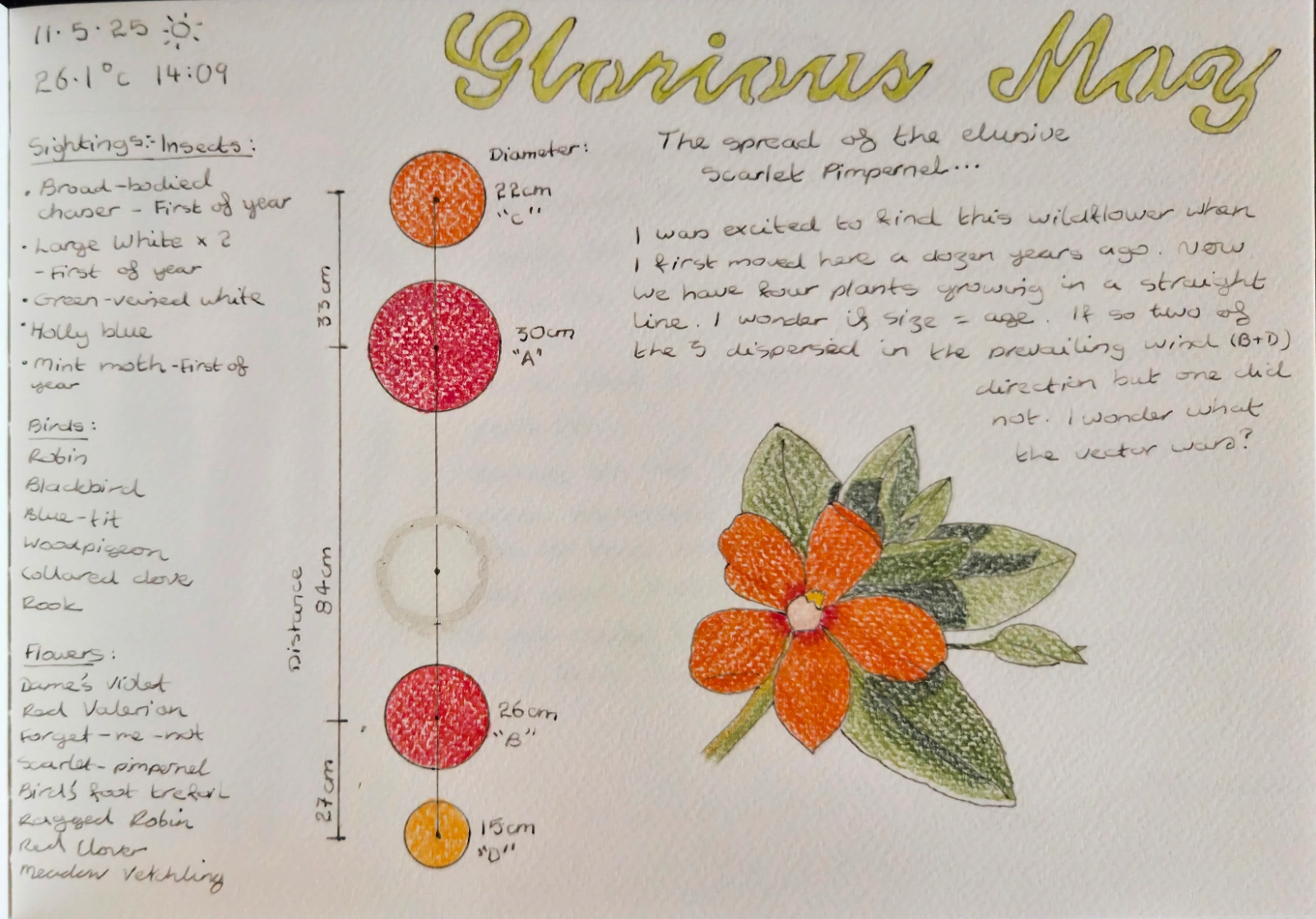
Despite its reputation for elusivity, here in Norfolk the Scarlet Pimpernel is a widespread and common native wildflower that flowers from May to October. It has long colloquially been known as Shepherd’s watch or Shepherd’s glass because of the flower’s reliable habit of opening in sunshine and closing up tightly in overcast, or rainy weather, as well as from midday or early afternoon. It was also called Bird’s Tongue for its red colour.
When I first moved here about a dozen years ago, I was very excited to find this pretty, diminutive, yet renowned wildflower growing on the edge of one of my flower borders. Now we have four plants growing in a surprisingly straight line. I wondered if their size was a reliable indicator of their age? If so, two of the three plants had dispersed in the prevailing wind direction but one of them had not. It made me wonder what the vector may have been instead, could it have been a bird or a rodent’s food perhaps?
I nature journalled a drawing of my plant and a linear bubble diagram of the plant’s dispersal with the size of the circles indicating the relative size of the plant.

A mobile phone snap of one of the plant’s flower stems:

Other Garden Wildlife sightings
Insects
- Broad-bodied chaser dragonfly – first for year
- Large White butterfly x2 – first for year
- Green-veined white
- Holly blue butterfly
- Mint moth – first for year
Birds
- Robin
- Blackbird
- Blue-tit
- Woodpigeon
- Collared Dove
- Rook
Flowers
- Forget-me-not
- Dames Violet
- Red Valerian
- Scarlet Pimpernel
- Birds’s-foot Trefoil
- Ragged Robin
- Red Clover
- Meadow Vetchling