As world cup fever gripped the Nation and England reached the football semi-finals for the first time in decades, I was instead becoming addicted to… moth trapping!
Here are just a couple of the visually amazing moths being attracted to my actinic lights:

White Satin Moth
The White Satin moth (Leucoma salicis) is a widespread and common species in Norfolk, historically recorded in nearly 92% of the county’s 10km grid squares since its first documented appearance in 1834. I was surprised to find it in my trap though. This insect usually thrives primarily in damp, wooded habitats such as poplar plantations, fens, and carr where its preferred host plants are abundant. During its larval stage, the caterpillars feed on aspens and poplars, as well as various sallows and willows. Its a fair way to the nearest large willow, although there are constantly young shoots around the pond that are there for a season before we pull them to protect the pond liner.
The adult moth emerges for its flight period during the mid-summer months, primarily active throughout July and August. It is easily recognized by its medium-sized wingspan of 37 to 50 mm, which exhibits a distinctive, glossy, silky-white appearance that gives the species its name. This striking white coloration is contrasted by a series of bold black and white rings on its legs and fine, feathered black and white antennae.
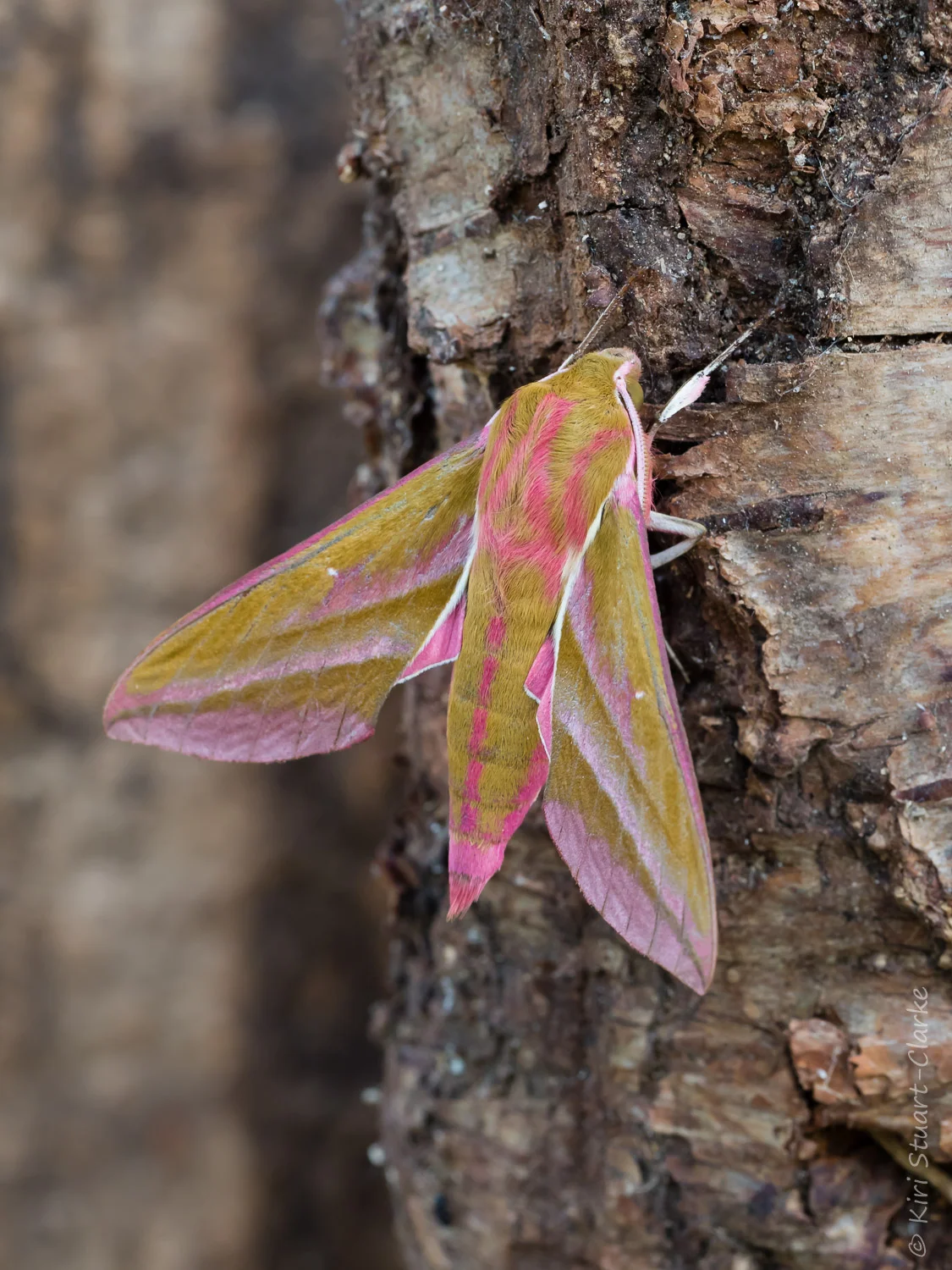
Elephant Hawk-moth

With a generous wingspan of 45 to 60 mm, the moth is instantly recognisable for its vividly coloured body, boasting a striking combination of golden-olive and electric-pink bars running across its wings and body.
The Elephant Hawk-moth (Deilephila elpenor) is a highly successful, common, and widespread species across Norfolk. It was less of a surprise to see it because this spectacular insect adapts remarkably well to a varied range of environments, thriving comfortably in open woodlands, rough grasslands, hedgerows, sand dunes, and heathlands, while also frequently visiting urban gardens and parks.
During their larval stage, the chunky caterpillars feed heavily on rosebay willowherb and other willowherbs, bedstraws, and enchanter’s nightshade, so they are probably using the bedstraws in my wildflower meadow and the willowherb growing up the lane. They are well known for turning up in domestic gardens to feed on cultivated fuchsias but I don’t have any in my garden.
The nocturnal adults have a relatively long flight period spanning from May through to early August, taking to the air at dusk to hover and feed on the nectar of deep, tubular flowers like honeysuckle, which is plentiful in my wildlife-friendly garden.
The common name of the species is actually derived from its fascinating caterpillar, which is a grey-brown colour with large, defensive eyespots behind its head; when threatened, the larva retracts its head and swells its body, making it closely resemble a miniature, swaying elephant’s trunk.