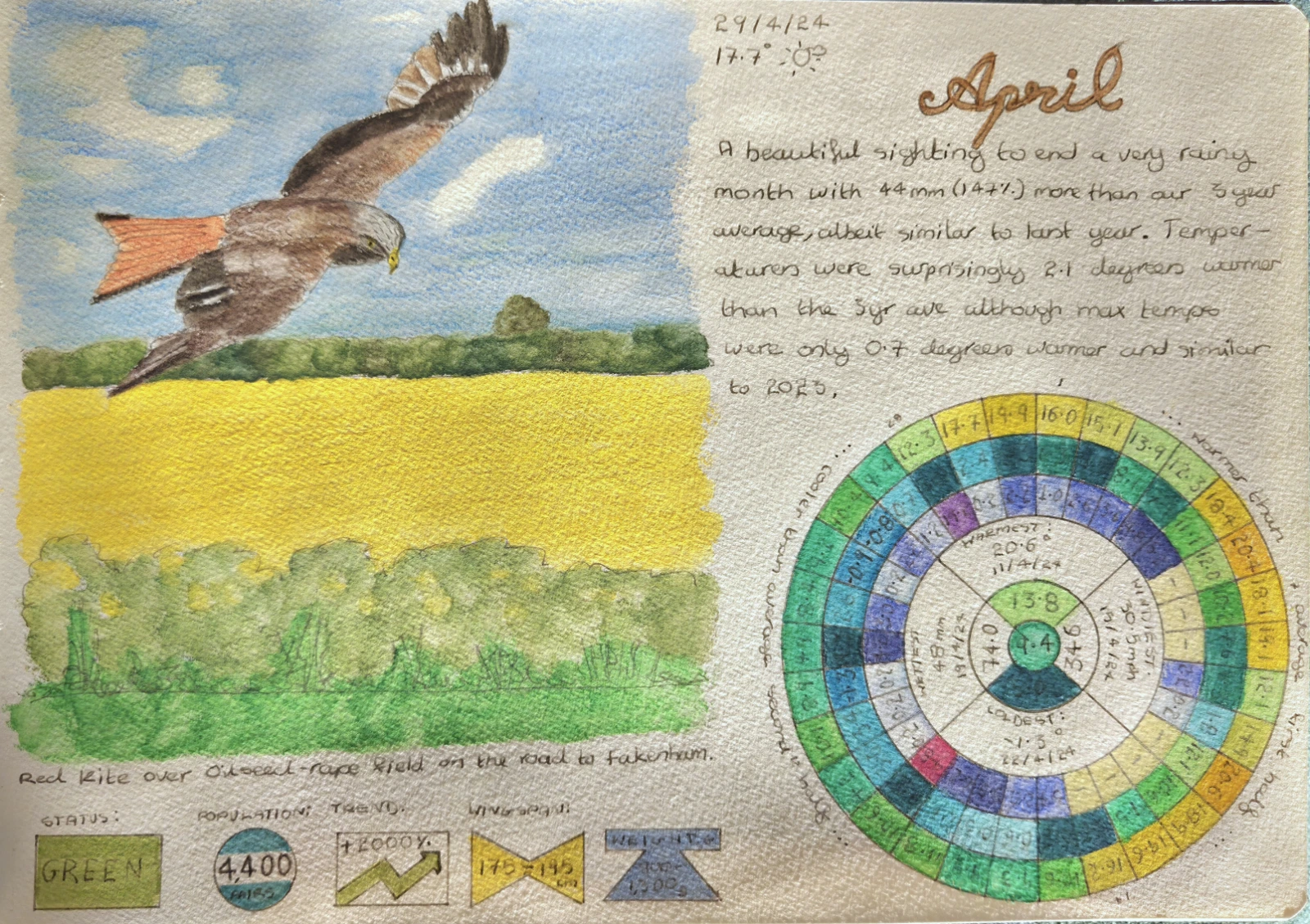
We spotted this soaring Red Kite on the road to a nearby market town, gliding gracefully over a brilliant yellow rapeseed field. It was a beautiful sighting to round off a very rainy month. We had 44mm (147%) more precipitation than our 3 year rolling average, albeit a similar quantity to last year. Average temperatures were, surprisingly, 2.1 degrees warmer than our 3 year average although maximum temperatures were only 0.7ᵒ warmer and similar to 2023.
Red Kites are a modern day conservation success story. In mediaeval times this charismatic bird of prey was common across British towns and cities, even protected by royal decree for their beneficial ecological role of scavenging street waste. From the 16th century onward, bounties, gamekeeping, taxidermy, and egg collecting all took its toll, eradicating them from England by the 1870s and Scotland by 1917. By the 1930s, only a handful of breeding pairs survived in remote central Wales. Strict nest protection kept this tiny remnant population alive, but it struggled to expand on its own.
In 1989, the RSPB and the Nature Conservancy Councils began translocating young chicks from Spain, Sweden, and Wales. Birds were first released in the Chiltern Hills in southern England and on the Black Isle in northern Scotland. Reintroduced birds successfully bred in the wild at both sites in 1992 and by 1994, wild-hatched kites were raising chicks of their own. Following this rapid success, further releases took place across the UK between 1995 and 2013, starting in Northampton. According to the British Trust for Ornithology, UK red kite numbers surged by over 2,000% between 1995 and 2024. They have thrived especially well in southern England, using motorway corridors like the M40 to scavenge roadkill although Scottish populations have struggled more due to ongoing persecution.
Thanks to nearby reintroductions, the rufous-tailed birds were a well established part of the landscape in South Oxfordshire where I lived in the late noughties, but Norfolk was never a release site and when I first moved to Norfolk in 2013 they were still noticeably absent from the skies. They simply weren’t here, at least not in any number, and I really missed them.
Thankfully the eastward expansion of the population continued from a local stronghold near Peterborough and in the last decade they have been an increasingly frequent sight in our area, so they do seem to finally be re-establishing here in mid Norfolk.
Red kites may be on the increase, but they remain vulnerable, and very much in need of protection. Sad to say a surprising number of people, mainly farmers and estate managers, who remain ignorant about their feeding habits, still trap and poison birds of prey in the mistaken belief that they are stopping them eating their livestock. In fact Red Kites have weak talons and are almost entirely opportunistic scavengers. The majority of their diet consists of carrion such as roadkill. When they do hunt it is only for small rodents and in spring and summer they also eat a lot of earthworms and beetles.
Today, nationally the UK hosts around 4,400 breeding pairs, making up roughly 15% of the global population. In a wonderful reversal, from 2022 conservationists have been collecting over 120 British-born chicks to reintroduce them into southwest Spain, where native Red Kite numbers had since crashed.
