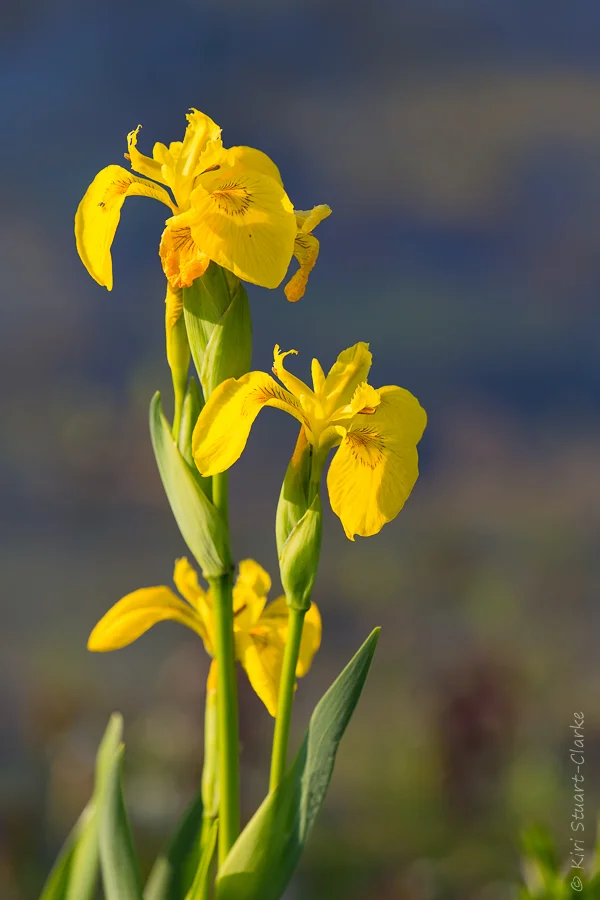

The Yellow Iris
The Yellow Iris, also named the Yellow Flag, Iris Pseudocorus, is one of surprisingly few native British pond Irises. The vibrant and beautiful Yellow Iris makes its home in the damp clay and loamy soils of wetlands and marshes. It thrives in the Fenland habitat of the Norfolk Broads and is widespread across the county.
Wildlife Value of Yellow Flag Iris
Yellow Iris is rich in wildlife value and a seasonally important nectar source. The plant was rated in second place for per day nectar production per flower in a UK plant survey project, supported by the UK Insect Pollinators Initiative.
Yellow Flag Iris is particularly popular with bees and hoverflies, who pollinate its hermaphrodite flowers. The drooping yellow tepals provide a landing platform for insects then the dark yellow patch in the centre, surrounded by a zigzag line acts as a guide directing the insect towards the nectar source.

Here in Norfolk I’ve observed Yellow Flag Iris providing a vital nectar source for a newly emerging Swallowtail butterfly.
Yellow Iris also acts as a caterpillar host plant for seven moth species including the Belted Beauty, Red Sword-grass and Water Ermine. The remaining four moth caterpillars, Crescent, Crinan Ear, Rush Wainscot and Webb’s live inside its thick reed-like stems.
Gardening Value of Yellow Iris
Sadly this species tends to gets overlooked by mainstream garden centres in favour of more popular blue-coloured Irises, those are actually Asian in origin and not native to the UK so do not afford the same value to wildlife.
With a little care, Yellow Iris can be a wonderful addition to most wildlife garden ponds. In particularly favourable conditions the Yellow Flag will thrive and can become a little over-vigorous, so growing it in containers is a good idea to avoid it taking off too dramatically, if you have a smaller pond or bog garden.
Fortunately my pond margin has plenty of room and mixed companion planting is providing healthy competition from other marginal plants such as Purple Loosestrife, Meadowsweet, Water mint, Reedmace (Typha), True Bulrush (Scirpus Lacustris) to name but a few. This approach has helped keep the pond margin mix nicely balanced.
Plant Folklore Surrounding Yellow Iris
Yellow Iris is steeped in a fascinating history, and fact and myth are closely interwined when exploring its history, mythology and folklore tradition. It is is widely said to be the original inspiration for the fleur-de-lis used in heraldic designs, however irises ties go back even further both historically and geographically, right back to the dawn and cradle of civilisation.
According to Kew, Yellow Flag is native throughout Europe to the Caucasus, grows from Norway and Finland in the north all the way down to the Mediterranean and into Northern Africa and the Near to Middle East, where it has a native presence in Algeria, Morocco, Tunisia and Turkey as well as Iran and the Levant.
A Potted History of Irises in Ancient Cultures
The Mysterious Minoans

Perhaps the most famous artistic representation of an iris in history belongs to the ancient Minoan Civilisation on Crete. At the Ammnisos “House of the Lillies” archaeologists discovered the “Iris fresco”. Dating to roughly 1550 BCE, it is thought to feature a stylized garden with iris flowers in a raised border, but there is historical uncertainty as it was heavily restored from small fragments.
At the Palace of Knossos itself, holes were drilled into rock to hold soil for bulbs, indicating the cultivation of irises took place directly inside palace architecture. However, these are thought to have been miniature Iris species.
Yellow Irises Introduction to ancient Egypt
The first solid historical evidence we have of ancient use of irises was around 70 years later in the Egyptian New Kingdom. The introduction of the plant to Egypt is historically tied to the reign of Pharaoh Thutmose III (c. 1479–1425 BCE), celebrated warrior-king and avid botanist.
During his grand military campaigns into the Levant and across the Euphrates River into Upper Mesopotamia (modern-day Syria), Thutmose III encountered an environment very different from the arid landscape of his homeland. There, growing natively along the fertile, marshy riverbanks of the Euphrates, was the Yellow Flag Iris. Furthermore, through trade and conquest, the Egyptians also came into contact with a different species: the White Flag Iris, Iris albicans. Botanists trace the native homeland of this hardy, bearded iris back to the Arabian Peninsula (modern-day Saudi Arabia / Yemen).
Fascinated by these vibrant new flora, Thutmose III ordered his soldiers to harvest the rhizomes of both the yellow Syrian native Iris pseucacorus and the white Arabian native Iris albicans. The durable nature of iris rhizomes would have allowed them to survive the long, hot journey back across the desert to Egypt, where they were successfully planted in imperial palace and temple gardens. White iris rhizomes develop an attractive scent when dried and would have been valuable as an ingredient in fragrance making.
To immortalize his botanical achievements, the Pharaoh had master sculptors carve precise reliefs of his exotic finds onto the limestone walls of his famous “Botanical Garden” rooms at the Karnak Temple Complex. Among the 275 plant species that he had documented in stone is the distinct, recognizable profile of several wild irises blooming in Egypt, probably for the very first time.


Irises in Greek Mythology
In ancient Greek mythology, Iris was a goddess who was the special messenger of Hera, the Queen Goddess. When Iris carried messages from Heaven to Earth, she used rainbows as her pathway.
In the myth of the seasons, the goddess Persephone was said to be collecting crocuses, lillies, irises and other flowers when she was snatched by Hades and taken to the Underworld. The species isn’t specified, there is speculation that it might have been the dwarf Greek Iris Strafe, however Yellow Iris’s range does extend into Greece and both species are yellow.
East meets West
Popular myth frequently attempts to trace the earliest fleur-de-lis symbology back to Mesopotamian antiquity, specifically to Sumerian religious and imperial iconography from the Uruk period (c. 4000–3500 BCE).
These early civilisations did utilise stylized, three-part geometric shapes called “palmettes”. The early ancient icons decorated cylinder seals to be used as imprints. Later more elaborate designs formed ornate “Tree of Life” motifs on Assyrian and Babylonian palace walls, there is no historical evidence that these abstract symbols were ever derived from or meant to represent a literal iris flower of any species.
In fact, the earliest historically confirmed visual twin to the modern fleur-de-lis originates from Byzantine Constantinople (modern-day Istanbul). It is preserved in a Christian mosaic within the Hagia Sophia, and dates to around 944 CE.
The famous South Vestibule mosaic depicts the Virgin Mary flanked by Emperors Justinian and Constantine the Great; an unmistakable triple-petaled emblem sits prominently on the rulers’ imperial robes. But not yet a symbol of French royalty, the Eastern Orthodox Church revered this icon as a “Wisdom Lily,” and used its three distinct petals to represent purity, divine wisdom, and the Holy Trinity.


Heraldic History of the Fleur-de-lis
Western European legend attributes the emblem’s shift from the church to the battlefield to the Frankish King Clovis I (c. 466–511 CE). Lore has it that he substituted three toads on his military banner for three Yellow Iris flowers after noticing the flowers growing shallowly in the River Leie (Lys). This biological marker told his army where the river was shallow enough to safely cross and enabled them to escape a battlefield.
Following Clovis’s conversion to Christianity, the stylized yellow iris gradually became a shorthand symbol for the Frankish kings, most notably Charlemagne (Karl der Große), who was crowned Holy Roman Emperor in 800 CE.
By the mediaeval period, the symbol evolved from a loose royal sigil into an official brand. According to Wikipedia, its first modern historical usage as a sigil was as the emblem of the House of Capet founded by Hugh Capet (c. 941–996) and through that lignage it passed on to become the official emblem of the French court. After Louis VII (c.1137 to 1180 CE) formally adopted the golden logo on a blue shield as his specific royal coat of arms during the Second Crusade, the fleur-de-lis became permanently fused with the national identity of France.
Yellow Iris and Mediaeval Superstition
As the Frankish Empire transformed into Catholic France, the Yellow Flag Iris developed deep roots within medieval Christian folklore. Increasingly referred to as the “Virgin’s Flower,” its anatomy, featuring three upright petals, invited immediate parallels to the concept of the Holy Trinity.
Because of its association with divine protection, the yellow iris developed a powerful apotropaic reputation, it was believed to actively ward off evil. In various Catholic regions, particularly Ireland, rural communities believed the plant could shield the home from dark spirits. Every summer, fresh bunches of wild yellow irises would be harvested from ditches and riverbanks and hung up outside front doors during the Feast of Corpus Christi to bless the household and keep misfortune at bay.
The Seventeenth Century and Gerard’s Herball
The 17th century herballist John Gerard called Yellow Iris the “floure-de-Luce“, with “Luce” perhaps derived from the old German “Liesch”, stating it “prospereth well in moist meadowes” and describing the flowers as being “of a perfect yellow colour“.


Traditional Local Names for Yellow Iris
Frequently known as “Daggers”, Yellow Iris has several other traditional vernacular names including Jacob’s Sword, Segg, Swordgrass Water Skeggs referencing its blade-like foliage as well as Flagon Fleur-de-lis, Flower-de-Luce, Gladdon (from older English also used for stinking iris), Water Flag and Yellow Flag alluding to its heraldic shape. It was also called False Acorus.
Historic Medicinal and Culinary Uses of Yellow Iris
Traditionally the dried roots were used medicinally from antiquity as a cathartic, an emetic and as an astrigent to halt bleeding, whereas the roast seeds were used to make a form of coffee, though there is considerable uncertainty as to its toxicity!
Other Traditional uses of Yellow Iris
The rhizomous roots yield a black dye and ink and are extremely acrid. The plant also generates a pleasant essential oil, which was often used to dilute that of the Sweet Flag, Acorus calamus, giving rise to one of Yellow Flag’s traditional alternative names, that of False Acorus.
In line with a long history of use for purification, it plays a role in modern day water purification processes. The roots are typically planted in a reedbed using a substrate such as lava-stone. The roots improve water purity by consuming pollutants, such as nitrogen and phosphate run off from agriculture, to use as nutrients.
Yellow Iris in Art and Literature
Steeped in history, myth and folklore as it is, references to the Yellow Iris span centuries of classical, medieval, and nineteenth-century literature. Because of the fact that the tall plant historically dominated European wetlands and riverbanks and that its flowers form a visual golden crown shape, it frequently acts as a symbol of royalty and heraldic power, as well as pure poetic beauty.
Shakespeare references Yellow Iris as the “fleur-de-Luce” in Henry V and Henry VI, possibly due to its French and heraldic connotations, but alludes to it with a clearer floral meaning in A Winter’s Tale:
“… lilies of all kinds,
William Shakespeare, A Winter’s Tale
The flower-de-luce being one! O, these I lack,
To make you garlands of, and my sweet friend,
To strew him o’er and o’er!”
And in 1579 Spenser compares other yellow flowers to the ” Flours Delice”. Kingcups are Marsh Marigolds, Pawnce are Pansy and Chevisaunce is thought to be a Wallflower:
Strow mee the grounde with Daffadown-Dillies,
Edmund Spenser, The Shepheardes Calender
And Cowslips, and Kingcups, and loved Lillies;
The Pretty Pawnce And the Chevisaunce
Shall match with the fayre Floure Delice.
Lastly, no discourse on Yellow Flag Iris would be complete without an image of one of impressionist painter Claude Monet’s many wonderful depictions of them (1914-1917).

Resources
Garden History Research Association
Catalogue of Claude Monet’s Paintings