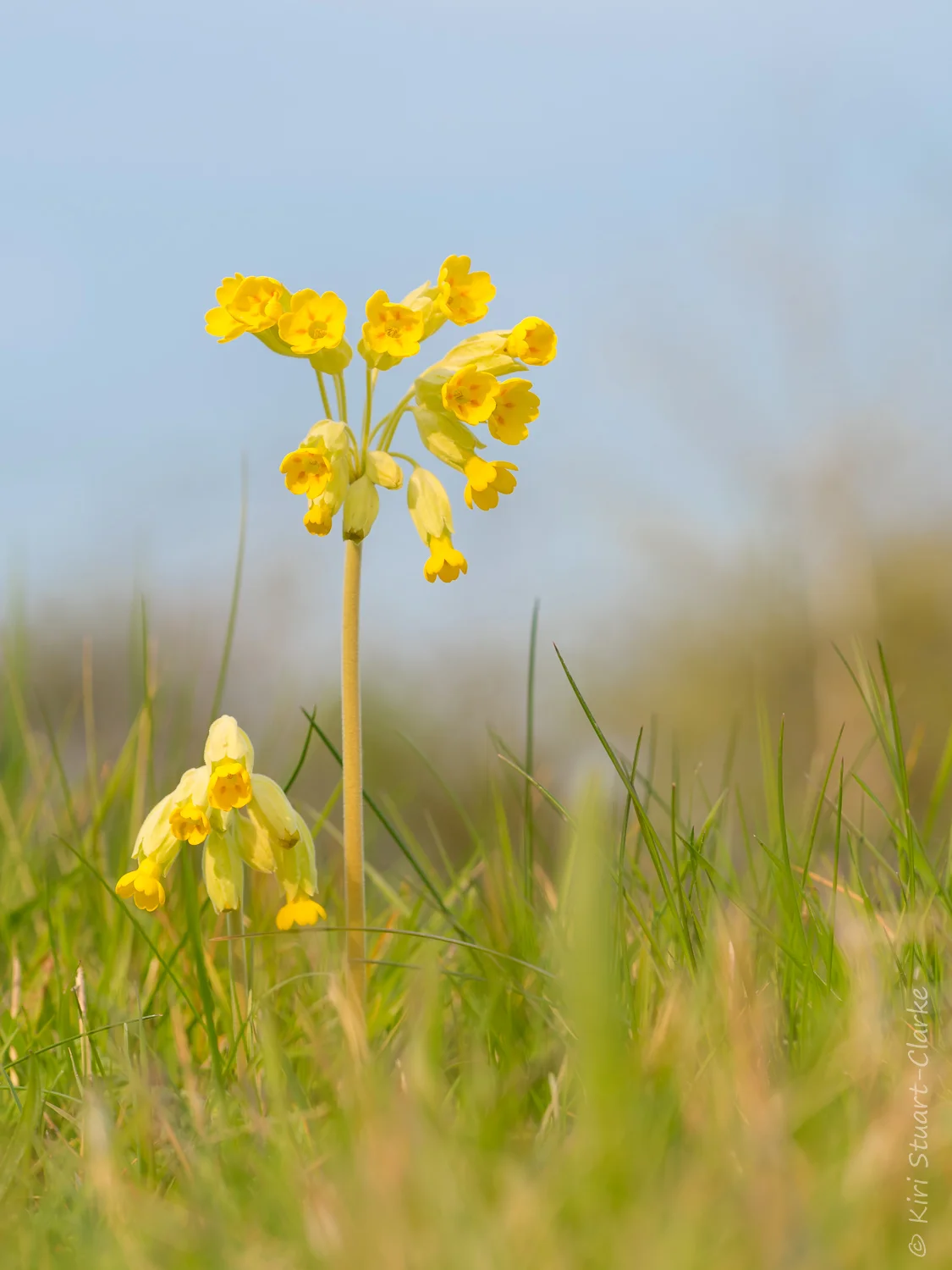

The mid-Spring superstar of our wildflower meadow this year was undoubtably the humble Cowslip, Primula veris. I’d always hoped to see them in my wildlife garden, as not far up the lane from my cottage is a little tucked away-clearing near a small copse that is too small to farm and in springtime always seemed to be bursting full of rich custard-coloured Cowslips mixing in beautifully with the deep indigo of native Bluebells.
Disappointingly, despite their inclusion in my native seedmix for clay soil, for the first two years not a single one materialised. I philosophically put it down to the soil conditions or an unlucky batch mix and thought I might sow some plugs another year.
Then unexpectedly, the very next spring just a smattering appeared! I was overjoyed to learn that it was simply that their seeds can take several seasons to germinate and interpreted it as an encouraging sign our meadow ecosystem was establishing itself well naturally.
Since then they’ve gone from strength to strength, spreading almost right across the small sward. They must particularly like cool dry springs as this year, our meadow’s sixth season, has been their best appearance to date.
Wildlife Value of Cowslips
Aside from their cheerful colour and long lasting flowerheads, our native primulas have a healthy wildlife value. Their flowers are a vital resource for pollinators, particularly for early solitary bee species, quite a few of which frequent our garden, but also for butterflies such as the Brimstone butterfly and other insects such as beetles. They are also the caterpillar plant for the Duke of Burgundy butterfly, which is unfortunately not resident in Norfolk.
A member of the Primula family, the Cowslip shares more than a passing resemblance to it’s cousins the Primrose Primula vulgaris and the Oxlip Primula elatior, however both of these lack its pleasant apricot perfume and have more open paler lemon-hued flowers.
Plant Folklore of Cowslips

Amusingly the Cowslip’s latin name Primula veris romantically deems it the “true” primrose, while its established English name more rustically refers to its habit of growing near “cow’s slops” or cowpats in grazing pasture.
Cowslip does have over two dozen pleasanter names in traditional folklore, which offer us a fascinating glimpse into our historical varied and deeply entwined relationships with the wildflower.
Paigle
Here in Norfolk, and across East Anglia the name Paigle was apparently widely used, whereas its common crossbreed the Oxlip tended to be known as Lady’s Fingers. With plant classification much less scientific than it is today, its likely both names were used fairly interchangeably.
Paigle’s etymological roots are obscure and lost in the mists of time. Its first recorded use was in Middle English around 1450, with alternative early spellings including pagil, pagle, peagle, and pygil. Paigle’s widespread use led to other name variations such as Buckles, Horse Buckle and Peggle.
Other local or folklore names included other farming and pastoral references such as Milk Maidens, Mayflower as well as plant-descriptive names such as Freckled face, Bunch of Keys, Golden Drops and Long legs, and Petty Mulleins (based on a leaf shape similarity)
Traditional Herbal Medicinal Names and Associations
Some of Cowslips’ long list of folklore names relate to its even longer history of medicinal use. Because cowslips were believed to be an excellent herbal remedy for stiff joints, gout and muscular rheumatism, medieval herbalists gave the plant the Latin name Arthritica. In localized English dialects, this was corrupted into Artetyke.
Cowslips were also thought to treat palsy or paralysis lending it the names Paralysio, Palsywort and Password. The Cowslip was also used medicinally to aid sleep and heal coughs.


Culinary Names and Usage
A pale golden wine was made from Cowslips called “Culverkey wine” that was more like like a sherry or honeyed mead leading to the name Culverkeys and Cove-keys. Beyond a social drink, traditional herbalists noted that cowslip wine possessed mild soporific (sleep-inducing) and calming properties, and was occasionally used as a home remedy for insomnia, anxiety, or headaches.
Cowslip Superstition and Religion
The Cowslip acquired many biblical names that referenced Mary, Our Lady, Peter, Keys or Heaven, alluding to a myth that Cowslips sprang up where St Peter had dropped the keys to heaven – perhaps in a cow pat! The German name is Himmelsschlüssel which translates to Heaven’s keys.
The Cowslip traditionally was used to decorate Mayday garlands and was strewn along churchyard pathways at weddings and religious festivals. In some places, children would give Vicars Tissty-Tossty balls on special church days.
Other Cowslip names related to traditional folk superstition, whimsy or customs, for example Fairy cups, Fairies’ Flower and names linked to Tisty-Tosty.
A Tisty-tosty” was a little ball made up Cowslip flower heads hung on a stretched string from the heads and then tied together in a tight bunch. These were aparrently then tossed to foretell variously the trade, location or name of the suitor.
Tisty-tosty, tell me true, Who shall I be married to?
Cowslips alternative names listed alphabetically: Artetyke, Arthritica, Buckles, Bunch of keys, Cove-keys, Crewel, Culverkeys, Drelip, Fairy Cups, Fairies’ flower, Freckled face, Golden drops, Herb Peter, Hey-flower, Paigle, Peggle, Key Flower, Key of Heaven, Lady’s fingers, Long legs, Milk maidens, Mayflower, Mary’s tears, Our Lady’s Keys, Palsywort, Password, Petty Mulleins, Plumrocks, Tisty-tosty.
Welsh: dagrau Mair meaning Mary’s tears, Anglo-Saxon: Cuy lippe, Greek: Paralysio.
Cowslips in Poetry and Literature
In the literary world the Cowslip’s honours include mentions in Shakespeare’s “The Tempest” and “Henry V” plays as well as featuring in Keats’ poem of Springtime romance “Hither, hither love”.
Hither, hither, love —
‘Tis a shady mead —
Hither, hither, love!
Let us feed and feed!
Hither, hither, sweet —
’Tis a cowslip bed —
Hither, hither, sweet!
‘Tis with dew bespread!
Hither, hither, dear —
By the breath of life —
Hither, hither, dear!
Be the summer’s wife!
Though one moment’s pleasure
In one moment flies —
Though the passion’s treasure
In one moment dies —
Yet it has not passed —
Think how near, how near! —
And while it doth last,
Think how dear, how dear!
Hither, hither, hither
Love its boon has sent —
If I die and wither
I shall die content!
John Keats


