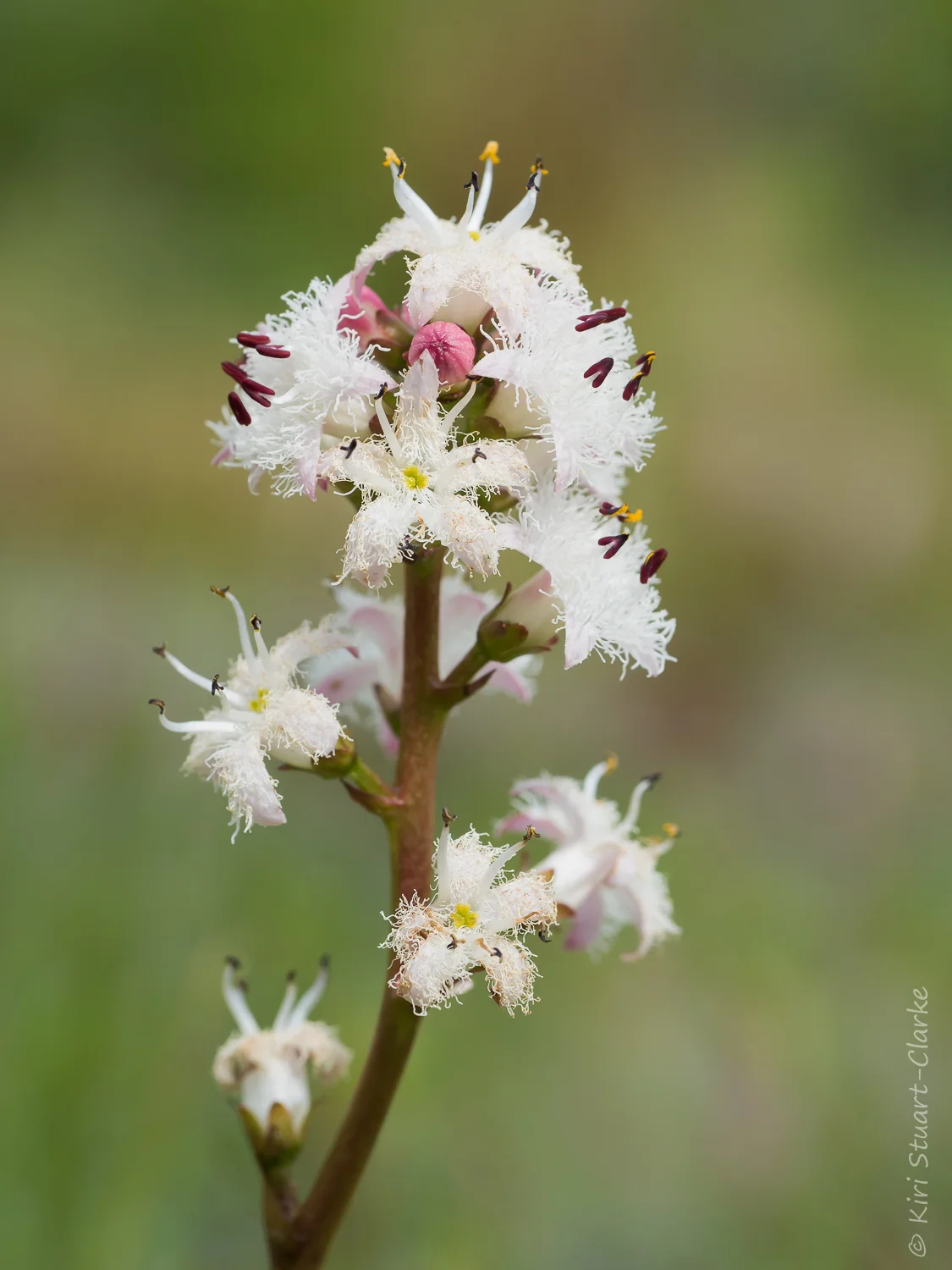
In the wild, Bogbean, Menyanthes trifoliata, is widespread in the marshes, fends and ponds across Northern England and Scotland, though sadly it is now less common in the South where it has suffered a marked decline due to habitat loss from wetland drainage. Here in Norfolk it is rather local but is recorded at some wetland nature reserves such as Rushmeadows and Sweet Briar Marshes.
Historically Bogbean was classified as being related to the Gentian flower family due to its bitter compounds. But with the advent of DNA sequencing it was discovered to be entirely unrelated and was moved into its own botanical bogbean family called Menyanthaceae.
Bogbean has a long and fascinating geological history. It has very durable seeds and is classified as a peri-glacial survivor. During the peak of the Last Glacial Period, when massive ice sheets crushed most European vegetation, bogbean seeds survived in the freezing tundra meltwater zones immediately bordering the glaciers.
But its timeline stretches even further back. In fact, fossil seeds of Menyanthes trifoliata have been extracted from Middle Miocene freshwater deposits in the West Carpathian Mountains of Poland that date back roughly 16 million years. These earlier fossils proved that bogbean thrived in swampy landscapes long before humans existed, and would have been co-existing with prehistoric fauna like three-toed horses, giant sloths, and early carnivores.

Wildlife Value of Bogbean
Bogbean is highly valuable to wildlife as a nectar resource. Its striking pink-tinged flower spikes grow up to 30cm tall and can blossom from March right through into June or July. The frilly white flowers attract bees, hoverflies and butterflies to the pond edge.
Bogbean’s tendency to grow by creeping horizontally across the water surface also serves to create shade and provides a rich micro-habitat for pond-dwelling insects.
In particular, Bogbean’s lobed trifoliate leaves form a kind of floating raft, which makes for an excellent egg laying, perching and roosting site for adult damselflies and dragonflies, whose nymphs subsequently use the protruding stems to climb out of the water when they are ready for metamorphosis.
Its also a caterpillar food plant for both the Elephant Hawk moth (Deilephila elpenor) and the Light Knot Grass (Acronicta menyanthidis).
Gardening Value of Bogbean
The Marilyn Monroe of aquatic plants, Bogbean flowers have tall spikes producing pink buds and downy-white, blush-tinged, star-shaped frilly flowers as exotic as those seen on any orchid or lily.
Bogbean’s gardening value speaks for itself; possessing such a beautiful and dramatic flower, it is not surprising that Menyanthes trifoliata is regularly cultivated in ponds and water gardens and it is rather ironic that this glamorous, wildlife-friendly, native wildflower superstar should bear such an unglamorous common name.
Alternative Traditional Names for Bogbean
The beautiful bogbean does have some less ugly alternative names though. Here in Norfolk its common name is Water-fluff, which I love and think I will adopt. Its latin name Menyanthes trifoliata refers to its triple leaved foliage and extended flowering season.
Bogbean is actually a late 18th century modification of ‘Buckbean’, the 16th century name translated by Henry Lyte (1578) from the Flemish ‘Bocksboonen’ in the herbal of Rembert Dodoens (1554). Lyte took this to mean ‘Goat’s beans’, the leaves resembling young leaves of the Broad Bean. Over time this morphed to better fit with the plant’s watery habitat.
In his General Herball of 1597, John Gerard referred to it as Water Trefoile or Bucks beans and stated that it was also known as Marsh Clover, Marsh Trefoil or Buckes beans, and noted the dutch names Biberklee and flemish Boczboonen. Its also known as Water Shamrock, Bog Myrtle and Buckbean.

Traditional Folklore Medicinal Uses for Bogbean
Meanwhile, in medicinal herblore Bogbean was said to be a cure for numerous ailments when drunk as a bitter tea, Gerard mentions using it with mead or honey for coughs and chest pains for example. One of its German names, Scharbock, is derived from the Latin scorbutus, an ancient term for scurvy, a disease that Bogbean was believed to cure.
Traditional Folklore Culinary Uses for Bogbean
One of its alternative names, “Bog hop”, alludes to Bogbean’s long history of herbal and medicinal use. Its leaves were traditionally used as a flavouring in beer making. The rhizome has also been dried and powdered for use as a substitute for bread flour.
Folklore Superstitions about Bogbean
Because Bogbean grows in marshy terrain, places traditionally viewed as portals to the Otherworld, it was thought to be highly attuned to the spirit world.
According to old folklore, bringing the plant into the home or harvesting it at the wrong time could invite restless dreams, nightmares, or the attention of mischievous bog entities like púca (pooka) or will-o’-the-wisps.
Conversely, in places like Devon, children used to recite rhythmic charms addressing “Biddy Bene” (derived from an Anglo-Saxon word for entreaty or prayer) when passing through terrifying dark tunnels or dangerous places. In these cases, invoking the plant’s name was a magical plea for a safe, “clean” passage away from unseen predators like foxes or lurking spirits.
“Buckee, Buckee, biddy Bene,
Is the way now fair and clean?
Is the goose ygone to nest,
And the fox ygone to rest?
Shall I come away?”
Bogbean in Poetry and Literature
Although Gerard/s contemporary Shakespear did not reference Bogbean in his plays, an old English dialect nickname for bogbean was “buckee”. Some etymologists have suggested this word shares roots with Puck, the mischievous bog-dwelling sprite from A Midsummer Night’s Dream.
English Romantic poet and novelist Charlotte Smith (1749–1806)was celebrated for her precise, hyper-local botanical focus, In her sweeping blank-verse work Beachy Head (1807), she uses the plant to paint a picture of the wild, smuggler-trodden coastal marshlands:
“Where the gemm’d sun-dew grows, or fring’d buck-bean,
They scare the plover”
Known as the “Northamptonshire Peasant Poet,” John Clare possessed an intimate knowledge of rural flora. He observed locals gathering bogbean for its bitter medicinal tonic properties. In The Village Doctress, he references the plant “shining in its mozzly dyes“, connecting it to soft, mossy wetland peat
