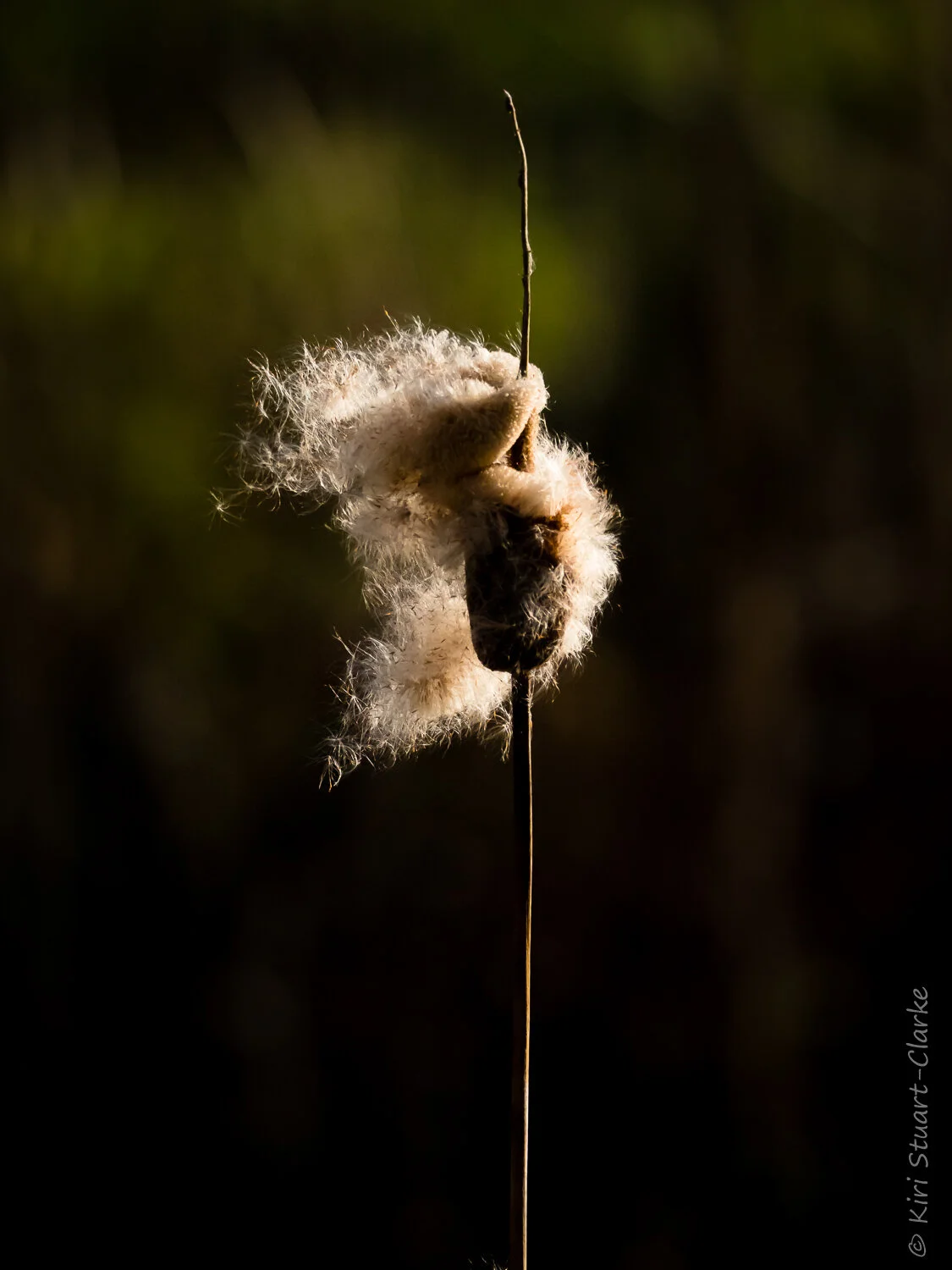

This winter is proving milder than usual and, so far, snowless but winter can be beautiful in many different ways. Certainly enjoying the beautiful seedheads of various native wildflowers is one such pleasure for me. Typha latifolia or Reedmace, known simply as “Bulrush” to most of us, flowers mid to late summer, but the large cigar-like seedheads last right through winter. This Common Reedmace seedhead was gently dispersing its myriad tiny seeds into a light steady breeze on a golden winter’s day.
Wildlife Value of Bulrush / Great Reedmace
Bulrush offers much more wildlife value than first might appear. It is an emergent marginal plant so its protruding leaf and flower spikes offer an emergence route for dragonfly and damselfliy larva and anchor point as they leave their watery life behind to metamorphosis. Meanwhile its bushy base clumps offer dense shelter from predators to all types of creatures visiting the water’s edge including newts, frogs, toads, shrews and, if you’re lucky, water voles.
Common reedmace supports four moth species in all. The three larger or “macro” moths are: the Bulrush Wainscot, Nonagria typhae, Webb’s Wainscot, Globia sparganii and the Rush Wainscot, Globia algae, all of which burrow into its thick stems. The aone small -”micro” moth – the Bulrush Cosmet, Limnaecia phragmitella lives in the Bulrush’s seed heads, along with other insects like the Bulrush bug Chilacis typhae. A further insect resident is the Common reed beetle Donacia aquatica, whose larval stage feeds on the Reedmace’s shoots and then pupates in its root system.
Gardening value of bulrush / Great reedmace
Common Reedmace flowers, though unassuming, are a surprisingly delicate creamy white but undoubtedly its greatest aesthetic value is in offering year round shape and form to a pond margin thanks to its dense bushy nature and broad tall spikey leaves. Additionally, its tall, cigar-like cylindrical seedheads form in late summer offer striking structural interest right through the winter.
Bulrush has historically been much maligned by traditional gardeners for its vigour and indeed its prolific seedheads, which can contain up to 200,000 seeds each, do mean it can be quick to spread and selfseed. However it is very easily pulled out if it starts expanding too enthusiatically and is a great addition to almost any sized wildlife pond. In smaller ponds it may be a good idea to plant it in containers to help rein in its expansionist tendencies.
Plant Lore of Bulrush / Great Reedmace
Common Names
Being a longstanding native of our lakes rivers and ponds and widespread right across the British Isles, Common Reedmace has nearly as many descriptive folklore names as its seedhead does seeds! Around 40 often colourful folklore names have been documented for it.
Many such as Black cap, Blackie toppers, Blackheaded laddies, Black Puddings and Hard-head reference the early dark seed head phase, some like Candlewick, Chimneysweep, Pokers, Flue brushes allude to its tall spikes, yet others still including Cat’s tails, Pussies, Pussy tails, Flax-tail evoke its late winter stage shedding fluffy seeds.
There are also variants with biblical, maritime and punitive connotations including Devil’s poker, Holy poker and Cat’-o’-nine-tails. A few linguistically more obscure names are there too such as Dod, Gladden, Levvers and Seg (perhaps an earlier form of sedge).
Ironically its most common name, Bulrush, isn’t strictly correct. The true Bulrush is actually Scirpus lacustris (also Schoenoplectus lacustris), also an emergent native but in a different plant family and often also called Common Club-rush to avoid confusion.

Superstitions surrounding Bulrush
Bulrush does carry one longstanding superstition, for some reason the seedhead spikes are traditionally believed to denote bad luck or death if brought into the house.
Culinary and Medicinal Use
Bulrush has a long herbal tradition as a first aid. The plant’s most frequent use was treating skin irritations, burns, and wounds, by using either the antimicrobial starchy gel found at the base of the leaves or by pounding the roots and rhizomes into a soothing poultice. Additionally, the plant was used for staunching bleeding, by harvesting the fluffy down from mature seed heads and packing open cuts.
It was was however also used internally to provide digestive or respiratory relief. Rural herbalists would boil the stems and roots into decoctions to treat diarrhoea as well as soothe conditions like whooping cough. Gerard waxes lyrical about using a powder of the seeds together with Gladioli, Betony and Horsetongue eggs to cure hernias , describing it as being the “most perfect remedy against the disease in children“!
Culinarily its roots used to be used like potatoes and ground to make a high protein flour, while its new shoots were used as an asparagus substitute.