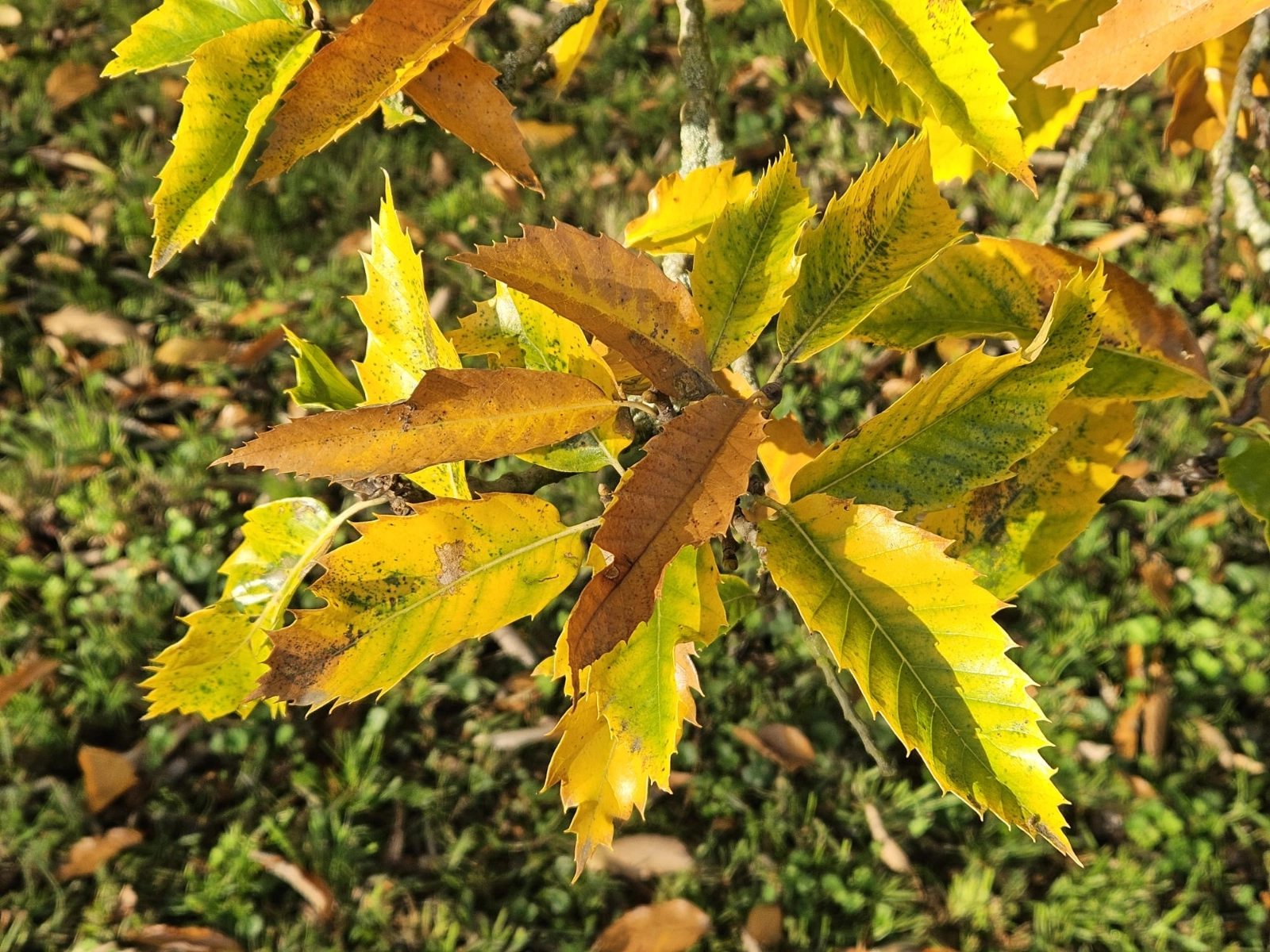
I’ve been watching the gorgeous autumnal colours in the leaves of our Sweet Chestnut tree, Castanea sativa, transition as autumn progresses.
The weather continues to be clear, cold and beautifully sunny, with deep blue skies. It made me wonder how much longer the leaves will continue stay on the tree for.
When you look closely, it’s surprising how much variation there still is, from leaf to leaf, in different parts of the tree, and within individual leaves. Some, mainly towards the base and at the tips of branches, still have a lot of green in them. Up in the canopy and at the crown of the tree they vary from yellow and golden through to a russet-brown. It made me curious about the leaf fall process and why it varies in different parts of the tree.
How do trees shed their leaves?
Trees actively shed their leaves through a controlled process called abscission, controlled by a hormone called auxin. Shorter days and cooler temperatures alter the tree’s hormone levels, lowering the growth hormone auxin and increasing levels of ethene. Ethene signals certain cells at the base of the leaf stalk (petiole) to either weaken their walls or expand causing them to separate similarly to perforated paper .
The green in leaves comes from chlorophyll, which the tree produces to use during photosynthesis. During leaf fall, photosynthesis ceases, the leaf’s chlorophyll breaks down and the tree pulls valuable nutrients back from its leaves into its branches and roots. This reveals hidden colours, first yellow and orange, and then protective purple or red-brown pigments are produced. A waxy, cork-like layer forms over the exposed branch join to block water loss, frost damage, and infections, before wind, rain or eventually gravity, finally separates the leaf from the tree.
Why do leaves at the top of trees turn first?
Leaves at the crown (top) of a tree receive more direct sun. The sun breaks down green chlorophyll faster and triggers higher production of red and purple anthocyanin pigments. Cold exposure plays a part too as, without upper branches acting as a blanket, top leaves lose heat faster on clear autumn nights, which triggers winter shutdown earlier. Higher branches also take the brunt of drying winds and sit farthest from the roots, causing them to switich off their leaves earlier to conserve moisture. Lastly the outer and upper shoots of a tree often mature earlier in the growing season, which naturally places them ahead at the end of the seasonal cycle.
A potted natural history of Sweet Chestnut trees in the UK
I’ve written about Sweet Chestnut trees before, so if you’d like to read a brief “potted” natural history of their arrival and naturalisation in the UK, check out my earlier blog post.

My reference photos for the beautiful autumnal Sweet Chestnut tree and leaves:


